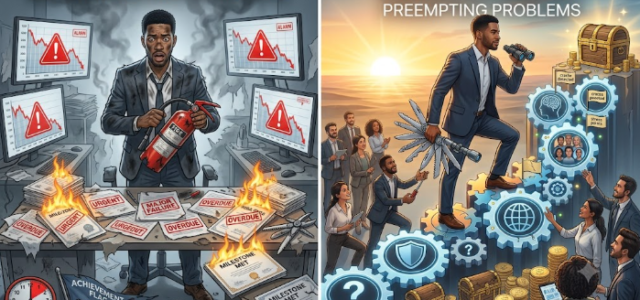
The Career Value of Learning to See Problems Before They Become Urgent
Some employees are very good at dealing with problems.
Give them a customer complaint, a missed deadline, a technical issue, or an unexpected request, and they know what to do.
They stay calm.
They find the cause.
They fix what they can.
They keep things moving.
That’s valuable.
But there is another level of professional skill that becomes increasingly important as your career progresses:
Noticing that something is likely to become a problem before everyone else has to deal with it.
Maybe you notice that a process is becoming slower even though nobody has complained yet.
Maybe you realize a project deadline is technically still achievable, but only if nothing else goes wrong.
Maybe you see that one employee has become the only person who knows how to perform an important task.
Maybe customers are repeatedly asking questions that suggest the instructions aren’t clear.
Nothing is technically “on fire” yet.
And that’s exactly why noticing it matters.

The ability to see problems early can make you valuable in a way that isn’t always obvious on a job description.
You aren’t simply solving problems.
You’re helping prevent some of them from becoming emergencies in the first place.
Urgent problems get attention. Early problems require awareness.
When something becomes urgent, everyone can see it.
A customer is angry.
A deadline has been missed.
A system has stopped working.
A shipment is late.
A project is over budget.
People start asking what happened.
Someone has to respond.
The employee who steps in and fixes the problem often receives recognition—and rightly so.
But imagine two employees.
One is excellent at solving the same recurring crisis every month.
The other notices why the crisis keeps happening and helps prevent it.
The second person’s contribution may be less dramatic.
There might be no emergency meeting.
No last-minute rescue.
No dramatic story about working late to save the project.
But over time, that person’s impact can be much larger.
Preventing problems is often less visible than solving them, but it can create more value.
Start noticing small changes
Most serious workplace problems don’t appear out of nowhere.
There are often small signals beforehand.
A process takes slightly longer.
People start asking the same question repeatedly.
A supplier becomes less reliable.
A customer begins mentioning the same concern.
A team depends heavily on one person.
A project requires more follow-up than it used to.
A certain type of mistake becomes more common.
None of these necessarily means something is wrong.
But they can be signals.
The skill is learning to notice patterns without immediately assuming the worst.
Instead of saying:
“We have a problem.”
you might ask:
“Is something changing here that we should understand?”
That’s a much more useful starting point.
Pay attention to repeated friction
One of the easiest ways to spot future problems is to watch for recurring friction.
Maybe everyone complains that approving a certain type of request takes too long.
Maybe new employees repeatedly struggle with the same software.
Maybe customers keep misunderstanding one part of the service.
Maybe your team spends twenty minutes every morning correcting information from another system.
People often dismiss these issues because they aren’t serious enough to fix today.
That’s understandable.
Everyone has limited time.
But repeated friction has a way of becoming expensive.
One small inconvenience multiplied by hundreds of customers or thousands of transactions can become a significant problem.
So when you hear:
“It’s always been like that.”
don’t automatically accept it.
Sometimes that’s a good reason to leave something alone.
Sometimes it’s exactly why you should investigate it.
Learn to distinguish a warning sign from ordinary noise
This is important.
If you try to predict every possible problem, you’ll become exhausting to work with.
Not every unusual event is a warning.
Not every delay indicates a crisis.
Not every complaint requires a new process.
Good judgment means knowing which signals deserve attention.
A useful way to think about it is to ask:
Is this isolated, or is it repeating?
Is the impact growing, or staying small?
Could the problem become harder to fix later?
Are more people becoming affected?
Would a small action now prevent a much larger action later?
Those questions help you avoid both extremes: ignoring everything until it becomes urgent and treating every minor issue as an emergency.
Look for problems that are getting harder to reverse
Some problems are relatively easy to correct.
Others become much more expensive once they grow.
That’s where early detection becomes especially valuable.
Imagine you notice that a project requirement is unclear.
Today, you could clarify it with one conversation.
Three weeks later, the team may have built the wrong thing.
Now fixing it requires rework, new approvals, missed deadlines, and frustrated stakeholders.
The underlying issue didn’t necessarily become more complicated.
The cost of ignoring it increased.
That’s one of the strongest reasons to develop this skill.
You’re not trying to predict the future perfectly.
You’re looking for situations where a small amount of attention now could prevent a much larger amount of work later.
Ask what happens next
A powerful habit is to think one or two steps beyond the immediate situation.
Someone misses a deadline.
Don’t only ask:
“Can we still finish?”
Ask:
“What does this delay affect?”
A customer requests an exception.
Don’t only ask:
“Can we accommodate them?”
Ask:
“What happens if more customers ask for the same thing?”
A colleague becomes overloaded.
Don’t only ask:
“Can I help them this week?”
Ask:
“What happens if this workload continues for six months?”
This kind of thinking moves you from task execution toward systems thinking.
You begin to see connections between today’s small events and tomorrow’s larger consequences.
Watch for single points of failure
One particularly useful warning sign is dependence on one person.
Maybe only one employee knows how to run a critical report.
Only one person knows a particular customer relationship.
Only one person understands an old system.
Only one person knows what to do when a certain problem occurs.
Being the expert can be valuable.
But excessive dependence creates risk.
If that person leaves, gets sick, changes roles, or simply becomes unavailable, the organization suddenly has a problem.
If you notice this happening, you don’t necessarily need to take over the work.
You could document the process.
Train another person.
Create a backup.
Simplify the procedure.
Make the knowledge easier to access.
That’s preventative thinking.
And it can demonstrate leadership without requiring a leadership title.
Look beyond complaints
Sometimes the most useful signals aren’t complaints.
People can adapt to inefficient systems for years.
They create workarounds.
They maintain spreadsheets nobody officially asked for.
They send manual reminders.
They copy information from one system into another.
They keep private notes because the official process doesn’t work well.
Those workarounds are clues.
If people repeatedly create unofficial solutions to the same problem, the organization may have an underlying process issue.
Instead of simply accepting the workaround, ask:
“Why do we need this workaround in the first place?”
That question can lead to much more valuable improvements.
Notice when a team is succeeding through effort rather than through a good process
This is another subtle warning sign.
Sometimes a process appears to work because talented people are constantly compensating for it.
A team hits every deadline—but only because people regularly work late.
Customers are happy—but one employee personally handles every difficult case.
Reports are accurate—but someone manually checks everything three times.
The outcome looks good.
The system underneath may not be.
This distinction matters.
A good result doesn’t always mean a healthy process.
Sometimes the biggest future problem is hiding behind today’s successful outcome.
Learn to ask “What changed?”
When something suddenly starts going wrong, people often focus on the immediate failure.
But a useful preventative question is:
“What changed before this started happening?”
Maybe the customer base changed.
Maybe the team became larger.
Maybe a supplier changed.
Maybe the software was updated.
Maybe a process that worked for twenty transactions a week is now handling two hundred.
Maybe the business grew but the supporting systems didn’t.
The original process may not have been bad.
The environment around it changed.
That is a powerful insight because many workplace problems aren’t caused by people suddenly becoming careless.
They’re caused by old methods being used in new circumstances.
Don’t wait for someone to give you permission to notice things
You don’t need to be a manager to develop this skill.
In fact, people doing everyday operational work often have some of the best information about emerging problems.
They’re the ones seeing:
- repeated customer questions,
- confusing instructions,
- inefficient steps,
- recurring errors,
- delays,
- unnecessary approvals,
- overloaded coworkers,
- and workarounds.
If you see something repeating, you can raise it thoughtfully.
You don’t have to walk into your manager’s office and announce that the entire system is broken.
Try something more useful:
“I’ve noticed this has happened four times this month. I’m not sure it’s a major issue yet, but I wonder if we should look at what’s causing it.”
That’s a much easier conversation to have.
You’re bringing an observation, not a dramatic conclusion.
Bring evidence instead of predictions
People are naturally skeptical of vague warnings.
Saying:
“I think this is going to become a huge problem.”
isn’t particularly persuasive.
Try:
“We’ve had five requests like this in the past three weeks, compared with one in the previous three months. If that continues, the current process may become difficult to manage.”
Now you’re connecting an observation to a possible consequence.
You aren’t claiming to know the future.
You’re showing why the pattern deserves attention.
That makes your judgment more credible.
Think about probability and impact
You don’t need to become a risk analyst to think about risk.
A simple framework can help.
Consider two questions:
How likely is this to happen?
How serious would it be if it happened?
A low-probability problem with enormous consequences may deserve attention.
A highly likely problem with very little impact may simply need a small process adjustment.
And a problem that is both likely and costly should probably move higher on the priority list.
This helps you avoid a common mistake: treating every possible problem as equally important.
They aren’t.
Prevention is not the same as pessimism
Some people hesitate to point out potential problems because they don’t want to sound negative.
They worry that they’ll become known as the person who always finds something wrong.
That’s not the goal.
There is a difference between saying:
“This won’t work.”
and:
“This could work, but I noticed one risk we should address before we commit.”
The second approach is constructive.
You aren’t trying to stop progress.
You’re trying to make progress more reliable.
The best problem-spotters aren’t constantly saying no.
They’re helping the team move forward with its eyes open.
Learn from people who consistently seem prepared
Think about the people at work who rarely seem surprised by predictable problems.
They aren’t necessarily smarter than everyone else.
They may simply pay attention to different things.
They know which customers tend to need extra communication.
They know which project stages usually cause delays.
They know which numbers look strange even when they technically fall within the acceptable range.
They know which small change can create a larger downstream problem.
If you work with someone like this, study their thinking.
Ask:
“What made you notice that?”
or:
“How did you know this might become an issue?”
Their answer may reveal patterns you’ve never considered.
That’s a practical way to develop professional intuition.
Turn recurring problems into career evidence
Preventative work can sometimes be difficult to explain because nothing dramatic happened.
If you prevent a problem, there may be no obvious “before and after.”
That’s why it’s worth documenting the work.
Instead of saying:
“Helped improve process.”
you might eventually be able to say:
“Identified a recurring source of delays, helped redesign the process, and reduced the amount of manual follow-up required.”
The exact result will depend on the situation.
Don’t invent numbers.
But do capture what changed.
Keep a simple record of:
- what you noticed,
- what pattern you saw,
- what risk it created,
- what you recommended,
- what action was taken,
- and what happened afterward.
This turns invisible problem prevention into visible career evidence.
Be careful not to become responsible for fixing everything
There is a trap here.
Once people realize you’re good at spotting problems, they may start bringing every issue to you.
That’s not sustainable.
Your goal isn’t to become the organization’s permanent warning system.
Sometimes your contribution should simply be:
“I’ve noticed this pattern.”
Someone else may own the solution.
That’s fine.
Good judgment includes knowing where your responsibility ends.
You can identify a risk without personally taking ownership of every possible fix.
Otherwise, a valuable skill can quickly turn into another version of being the person who always gets extra work.
The strongest professionals often make problems look smaller
There’s something interesting about people who are good at preventing problems.
Their work can make them look less busy.
They don’t necessarily have dramatic emergencies to talk about because they’ve already dealt with issues while they were still manageable.
They clarify expectations before the project starts.
They document processes before someone leaves.
They identify risks before deadlines become impossible.
They fix recurring causes instead of repeatedly treating symptoms.
They ask questions early.
From the outside, this can look almost uneventful.
But that’s the point.
Good preventative work often creates calm by removing reasons for panic later.
Start with one small habit
You don’t need to suddenly become an expert in risk management.
Try one habit for the next few weeks.
At the end of each workday, ask yourself:
“What felt slightly harder today than it should have?”
Maybe something took longer.
Maybe someone was confused.
Maybe you had to repeat the same explanation.
Maybe a customer asked the same question again.
Maybe a project required unexpected follow-up.
Write down the pattern.
Don’t immediately try to fix it.
Just observe.
After a few weeks, review what you’ve collected.
You may discover that several “small” problems have the same underlying cause.
That’s where the real opportunity begins.
Your career can grow when people trust your foresight
Most employees become known for something.
Some are fast.
Some are reliable.
Some are technically excellent.
Some are great with customers.
Some are excellent communicators.
Another valuable reputation is:
“They tend to notice things before they become problems.”
That reputation can matter enormously.
Managers want people who can anticipate issues.
Project leaders need people who identify risks early.
Customers value people who understand what might go wrong before it affects them.
Teams benefit from people who see dependencies others haven’t considered.
Organizations need employees who don’t simply react to whatever happens next.
You don’t need to predict every problem.
You need to become better at noticing the signals that deserve attention.
The real advantage isn’t predicting the future

You will still miss things.
Some problems will appear unexpectedly.
Some warnings won’t lead anywhere.
Some situations will change despite your preparation.
That’s normal.
The goal isn’t perfect prediction.
It’s developing the habit of looking beyond the immediate task.
When something changes, you notice.
When the same friction repeats, you investigate.
When a dependency grows, you question it.
When a process starts requiring more effort, you ask why.
When a small issue could become expensive later, you raise it early.
And when you see something that doesn’t yet require urgent action, you don’t automatically ignore it.
The people who create the most value aren’t always the ones who are best at fighting fires. Sometimes they’re the ones who notice the smoke while everyone else still thinks the room is fine.
That ability—to see what is coming before it becomes urgent—isn’t just a useful workplace habit.
It’s a form of professional judgment.
And the more responsibility you take on, the more valuable that judgment tends to become.
Related Posts