Why Your Career Can Change When You Start Thinking Like an Owner
There is a point in many careers when doing your job well stops being enough.
You can finish your work on time.
You can follow the process.
You can be dependable.
You can even be the person your manager trusts when something needs to get done.
And yet, your career can still feel strangely stuck.
One reason is that you may be thinking about your work entirely from the perspective of an employee.
You ask:
“What am I supposed to do?”
An owner asks a slightly different question:
“What needs to happen, and what can I do about it?”

That difference sounds small.
At work, it can change the kind of problems you notice, the decisions you make, the conversations you have, and eventually the opportunities people trust you with.
Thinking like an owner doesn’t mean acting like you’re the CEO.
It doesn’t mean taking control of everything, ignoring your manager, or working longer hours.
It means developing a stronger sense of responsibility for the outcome—not just your part of the process.
And that mindset can make your career much more flexible.
Employees See Tasks. Owners See Outcomes.
Imagine you’re responsible for preparing a weekly report.
An employee-focused approach might be:
“I need to finish the report by Friday.”
An ownership-focused approach is:
“What is this report actually being used for?”
Maybe the report helps a manager decide where to allocate resources.
Maybe someone uses it to identify customers who need attention.
Maybe nobody really uses half of it anymore because the process hasn’t been reviewed in years.
The second way of thinking changes the work.
You start looking beyond completion.
You become interested in whether the work is actually useful.
This is an important career shift because higher-level roles usually involve more than completing assigned tasks.
They involve deciding what matters.
They involve noticing problems before they become bigger problems.
They involve understanding consequences.
And they involve making choices when nobody has given you a perfect set of instructions.
That’s where ownership becomes valuable.
Thinking Like an Owner Doesn’t Mean Doing Everything Yourself
This is an important distinction.
Some people hear “take ownership” and interpret it as:
“Never ask for help. Handle everything yourself.”
That’s not ownership.
That’s often just overload.
An owner understands when to involve other people.
If a problem affects another team, you bring them into the conversation.
If you don’t have enough information, you ask.
If a decision requires authority you don’t have, you escalate it.
If someone else is better positioned to solve part of the problem, you involve them.
Ownership is not about personally touching every task.
It’s about caring enough about the result to make sure the right things happen.
Sometimes the most responsible thing you can do is say:
“I can’t solve this alone, but I know who needs to be involved.”
That is very different from simply passing the problem away.
Start Asking “Why Does This Matter?”
One of the easiest ways to develop an ownership mindset is to become more curious about the reason behind your work.
You don’t need to challenge every instruction.
You simply need to understand the context.
If you’re asked to contact ten customers, ask yourself what the goal is.
If you’re asked to update a spreadsheet, understand what decision depends on it.
If you’re asked to fix a recurring issue, look at why it keeps happening.
If you’re asked to attend a meeting, understand what needs to come out of that meeting.
The question isn’t:
“Why are they making me do this?”
It’s:
“What is this work supposed to accomplish?”
That question gives you context.
Context gives you better judgment.
And better judgment is one of the things that becomes increasingly valuable as your career progresses.
Owners Notice Problems Other People Walk Past
Every workplace has recurring problems.
A report that takes too long.
A customer question that gets answered repeatedly.
A process that requires unnecessary steps.
A handoff between departments that constantly causes confusion.
A spreadsheet everyone depends on but nobody really understands.
A meeting that happens every week without producing much.
An ownership mindset makes you notice these things.
But there’s a warning here.
You don’t need to fix every annoying thing you see.
That’s how people become permanently responsible for everyone else’s problems.
Instead, learn to distinguish between a problem worth solving and a problem you’re simply irritated by.
A valuable problem usually has some combination of:
- repeated impact
- wasted time
- customer consequences
- financial consequences
- unnecessary risk
- confusion between teams
- opportunities for improvement
If you can identify those patterns, you’re no longer just completing work.
You’re starting to understand the system around your work.
That’s a much more transferable career skill.
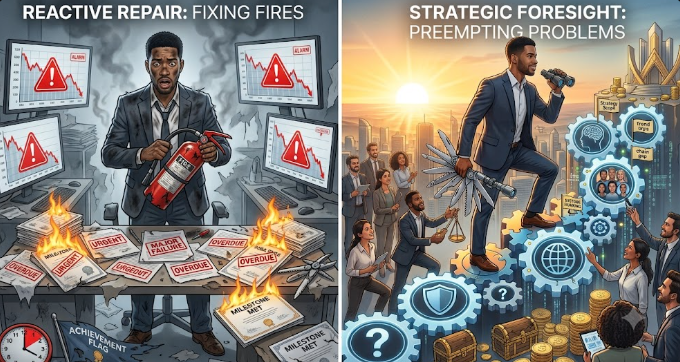
Stop Measuring Your Value Only by How Much You Finish
A busy employee can complete twenty tasks.
An owner might prevent ten unnecessary tasks from ever happening.
That’s why productivity alone isn’t a perfect measure of career growth.
Suppose you spend six hours every week manually correcting the same problem.
You become extremely good at correcting it.
Your manager appreciates your reliability.
But another person notices the underlying cause and spends a few hours fixing the process.
The second person may have completed fewer tasks.
They may nevertheless have created more value.
This is one of the biggest mindset changes in a growing career:
Don’t just ask how much work you can handle. Ask whether the work needs to be handled that way at all.
Efficiency matters.
But understanding what deserves your attention matters too.
Think About the Business, Not Just Your Department
You don’t need an MBA to understand how your work connects to the organization.
Start with simple questions.
Who uses the output of my work?
What happens after I finish my part?
What does my team depend on?
What does the next team need from us?
Where does the customer experience change because of our work?
What costs the company time or money?
What creates risk?
What does leadership seem to care about right now?
You don’t need perfect answers.
Even partial understanding can make you better at making decisions.
For example, you might realize that completing something one day faster isn’t particularly important, but reducing errors is extremely important.
Or you might discover that another department has been struggling because of something your team does without realizing the downstream effect.
Once you see those connections, your work becomes bigger than your job description.
Ownership Changes the Questions You Ask Your Manager
There is a big difference between these two conversations.
“What should I work on next?”
and:
“I noticed these two issues are creating delays. I think we could address one of them by changing this part of the process. Would you be comfortable with me looking into it?”
The second conversation demonstrates initiative without pretending you have authority you don’t have.
Another example:
“I’ve been handling this process for a while, and I think there may be a simpler way to do it. I’d like to test an alternative on a small scale before changing anything broadly.”
That’s a much stronger signal than simply asking for more work.
You’re showing that you can observe, think, propose, and take responsibility.
Those are the behaviors managers often need from people moving toward greater responsibility.
You Start Thinking About Consequences
Following instructions is relatively straightforward when the path is clear.
Ownership becomes more important when the consequences aren’t obvious.
Imagine you’re about to make a change that will save your team time.
An employee might focus on the immediate benefit:
“This is faster.”
An owner thinks a few steps further:
“What happens to the customer?”
“What happens to the next team?”
“What could break?”
“What happens if this works at ten times the current volume?”
This doesn’t mean overthinking everything.
It means learning to look beyond the immediate task.
That habit becomes increasingly useful as you move into roles involving projects, operations, management, client relationships, strategy, or decision-making.
You Become More Comfortable With Incomplete Instructions
Many early-career jobs come with relatively clear instructions.
Do this.
Then this.
Submit it here.
Follow this process.
As your responsibilities increase, the instructions often become less complete.
Someone might say:
“We need to improve this process.”
That’s not a checklist.
You have to figure out what “improve” means.
You have to investigate the current situation.
You have to identify constraints.
You have to decide what information matters.
You may need to propose options.
And eventually, you need to make a recommendation.
Thinking like an owner prepares you for that transition.
Instead of waiting for someone to define every step, you learn to create the next step yourself.
That’s a major career advantage.
Ownership Also Means Knowing When to Say No
This part gets overlooked.
If you think like an owner, you don’t automatically say yes to everything.
You ask whether the request supports the actual goal.
Sometimes the best response is:
“I can do that, but it will delay X. Which should be the priority?”
That’s not refusing to help.
It’s making the trade-off visible.
An owner understands that time, attention, money, and people are limited.
Everything cannot be the highest priority.
Learning to make those trade-offs is a career skill in itself.
And it can help prevent you from becoming the person who is always overloaded simply because you’re willing to accept every request.
Don’t Confuse Ownership With Control
Some of the worst workplace behavior comes from people who believe they are demonstrating ownership.
They start making decisions without informing others.
They interfere with other people’s responsibilities.
They refuse to delegate.
They become territorial.
They assume their solution is automatically the right one.
That’s not ownership.
It’s control.
Real ownership includes communication.
You can care deeply about the outcome while still respecting other people’s responsibilities and expertise.
Sometimes ownership looks like leading.
Sometimes it looks like coordinating.
Sometimes it looks like supporting someone else who owns the decision.
And sometimes it means recognizing that a problem isn’t yours to solve.
Good judgment includes knowing the difference.
Your Reputation Can Change
When people consistently see you thinking beyond your immediate tasks, they may start giving you different kinds of work.
Instead of:
“Can you finish this?”
you may start hearing:
“Can you take a look at this?”
Then:
“What do you think we should do?”
And eventually:
“Can you own this?”
That progression matters.
Your career often changes before your job title does.
People begin trusting you with more ambiguity.
They ask for your judgment.
They involve you earlier in projects.
They expect you to notice problems.
Those are signs that your professional reputation is expanding.
And that reputation can become more valuable than simply being known as someone who works hard.
Build Evidence of Ownership
If you want this mindset to actually affect your career, don’t leave it as a vague personality trait.
Collect evidence.
Keep track of moments when you:
- identified a recurring problem
- improved a process
- prevented an issue
- made a useful recommendation
- coordinated people across teams
- handled an unclear situation
- reduced unnecessary work
- helped a customer or colleague solve a difficult problem
- made a decision with limited information
- took responsibility for an outcome
These examples become useful later.
They can strengthen your resume.
They can give you better interview stories.
They can support a promotion conversation.
More importantly, they help you see your own career differently.
Instead of thinking:
“I spent three years doing this job.”
you can start thinking:
“Over those three years, I learned how to solve these kinds of problems, make these kinds of decisions, and improve these kinds of situations.”
That’s a much stronger career story.
You Don’t Need to Own a Business to Think Like an Owner
You can develop this mindset anywhere.
A receptionist can notice a recurring scheduling problem.
A customer-service employee can identify a pattern in complaints.
A designer can recognize why revisions keep happening.
An analyst can question whether a report is actually helping decisions.
A technician can find the cause behind repeated failures.
A project coordinator can notice where handoffs consistently break down.
A manager can improve how the team allocates its attention.
Ownership isn’t tied to seniority.
The size of the problem changes with your role.
The mindset doesn’t have to.
The Real Career Advantage
The biggest benefit of thinking like an owner isn’t that your manager will notice you.
They might.
But that’s not the deeper advantage.
The deeper advantage is that you begin developing skills that travel with you.
You learn to understand outcomes.
You recognize problems.
You make trade-offs.
You think about consequences.
You communicate across boundaries.
You work with incomplete information.
You take responsibility without needing constant instructions.
Those abilities can matter in many different jobs.
And that’s what makes them valuable.
A narrow task can disappear when technology changes.
A particular process can disappear when the company reorganizes.
A job title can become less relevant.
But the ability to understand a problem, figure out what matters, and help move things toward a useful outcome is much harder to make irrelevant.
Start With One Small Change

You don’t need to suddenly behave like you’re running the company.
Start with one responsibility you already have.
Instead of asking only:
“How do I complete this?”
ask:
“What is this supposed to accomplish?”
Then ask:
“What happens after I’m done?”
Then:
“Is there anything here that could work better?”
And finally:
“What part of this outcome can I responsibly take ownership of?”
Those questions can gradually change the way you work.
And when the way you work changes, the kinds of opportunities you’re ready for can change with it.
Your career doesn’t always move forward because someone gives you a bigger title.
Sometimes it moves forward because you start seeing your existing work differently.
You stop waiting for instructions to define your value—and start becoming someone who can understand what needs to happen next.
Related Posts